A Mess of Memory System Benchmarking, Simulation and Application Profiling
A comprehensive framework for memory system analysis, recognized as MICRO-57 Best Paper Runner-Up, now available for the research community
Download
Here is how Mess works
A unified approach to memory system analysis through three integrated components.
Here is how Mess works
A unified approach to memory system analysis through three integrated components.
Mess Benchmark
Describes the memory system performance with a family of bandwidth-latency curves.
Mess Simulator
Analytically adjusts the rate of memory instructions (provided by a CPU simulator) to the actual memory performance.
Mess Application Profiling
Determines positions of application execution-time segments on the corresponding memory bandwidth-latency curves.

Stay updated
with our progress
A snapshot of the Mess team's most
key announcements and updates.

Mess 2.0 Released
The Mess Benchmark has been completely redesigned in C++, delivering 84× faster performance with zero setup cost and full CLI configurability.
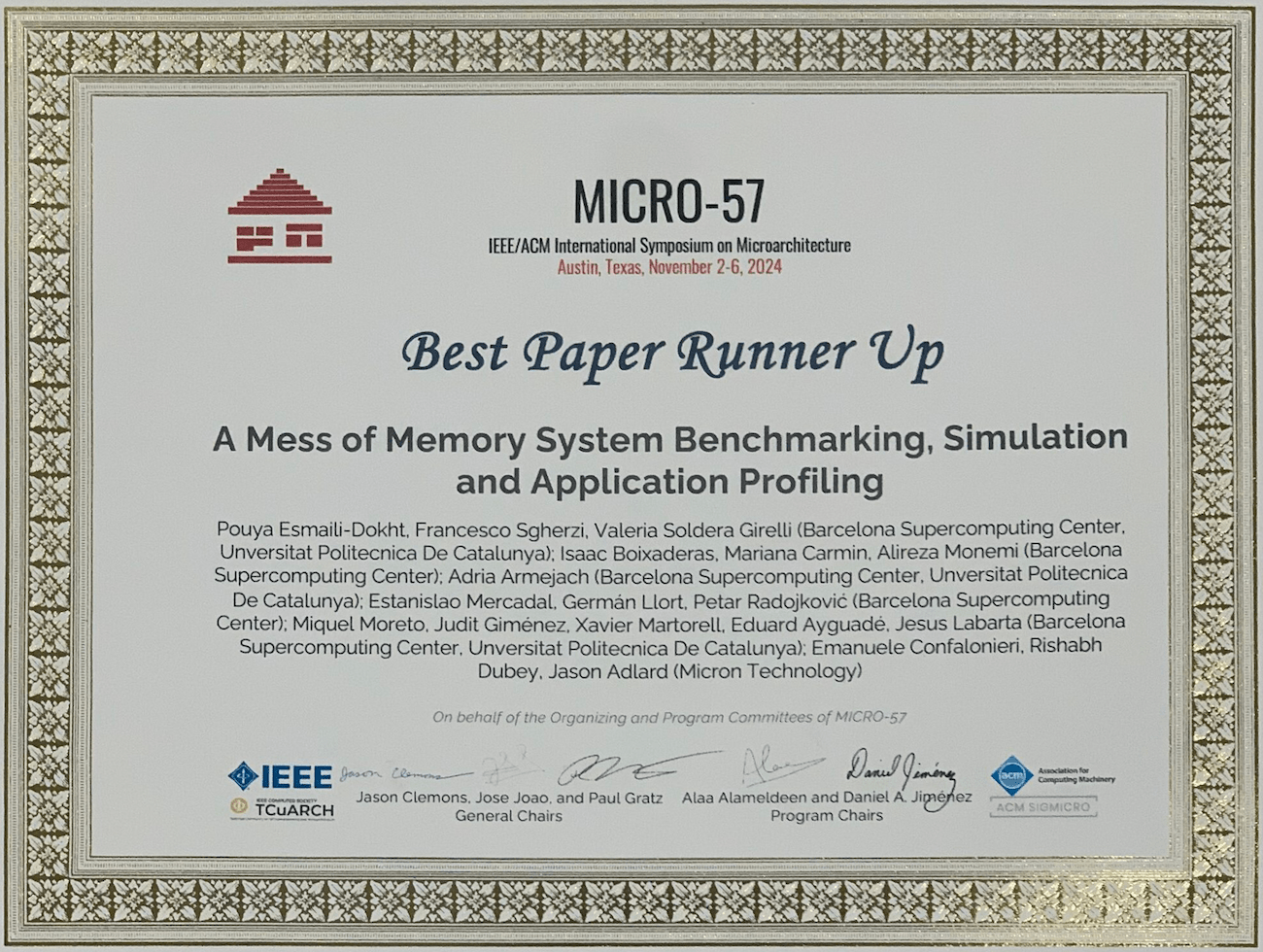
MICRO-57 Best Paper Runner-Up
Recognized as Best Paper Runner-Up at the 57th IEEE/ACM International Symposium on Microarchitecture.


This work is part of the Memory Systems Team, focused on the design and evaluation of next-generation memory architectures for HPC and AI. Our research addresses performance, power, and reliability challenges in modern memory systems.
Share knowledge,
build together
Access comprehensive tutorials, materials,
and collaborative resources from the community.
Conference Tutorials
Sessions from leading conferences worldwide
Learning Materials
Comprehensive resources to use Mess
Collaborations
Connect with researchers and practitioners globally
Where can I find Mess?
Explore different ways to integrate and use Mess in your projects.

Integration with simulators
Hooks for OpenPiton, gem5, DRAMSim3, and others.

Standalone simulator
Simplified version of the Mess Simulator for studying memory performance and testing integrations.

Benchmark
Assembly-level kernels and tools to measure bandwidth–latency behavior across CPUs and GPUs, providing detailed characterization of memory systems and technologies.

System results
Curated outputs and figures across common CPUs and GPUs platforms.
Need some help?
Learn more about the team and get in touch. You'll find:
- Information about the BSC Memory Systems team
- Meet the developers behind Mess Framework
- Direct contact options to reach the team

Workshop slides
PDF decks and speaker notes

Hands-on notebooks
Ready to run examples

Setup manuals
Step-by-step guides